
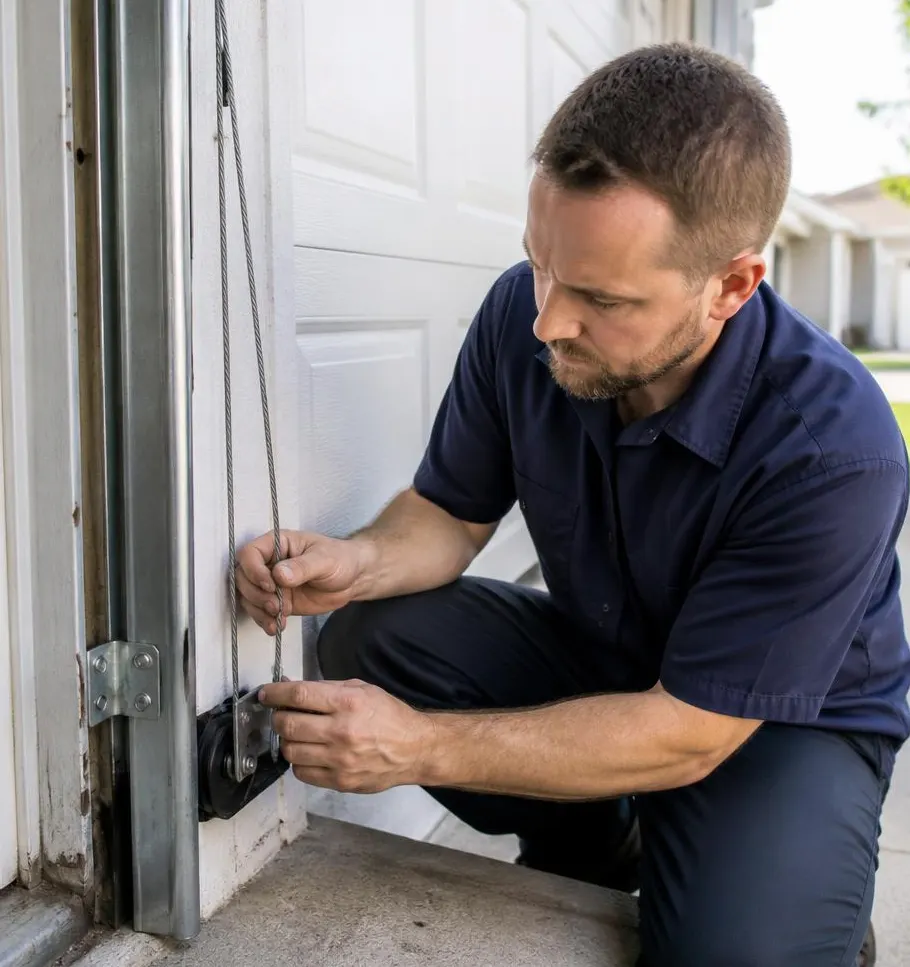
What It Costs You to Keep Opening a Door on Bad Tracks
A door that's rubbing against a bent track doesn't fix itself with another month of use. Every open-and-close cycle wears the roller against the wrong angle of metal, which chews up the roller, stresses the hinges next to it, and pulls the panel seams slightly out of true. Left through another season of monsoon grit and the first cool nights of fall, a track that's off by a quarter inch today can be off by an inch by spring — and at that point you're usually replacing rollers, hinges, and sometimes a panel instead of just straightening a bracket. The opener also pays for it: it keeps trying to pull a door through a path that's fighting it, which burns out gears and strips the drive mechanism well before its time.
Symptoms That Point to Track Trouble
- The door rubs, scrapes, or squeals at the same spot every time it opens or closes.
- It hesitates or jerks partway through the cycle, then continues.
- You see daylight or a visible gap between a roller and the track at one section.
- The door looks crooked in the opening when closed — tighter on one side than the other.
- It reverses on its own partway down, even though nothing is blocking the sensors.
- One section of track has a visible kink, dent, or outward bow when you look down its length from the bottom.
Any one of these on its own might be something else. Two or more together, especially rubbing plus a visible gap, almost always means the track geometry has shifted.
Causes, Checked in the Order a Technician Would Look
1. Loose or shifted mounting brackets
This is the first thing checked because it's the most common and the easiest to confirm. The vertical and horizontal tracks bolt to the framing and ceiling through brackets, and those bolts loosen over years of vibration from daily use. A technician runs a hand along each bracket checking for play. If a bracket has simply slipped, the fix is re-positioning it against a level reference and re-torquing the hardware — no new parts needed, and it often resolves rubbing immediately.
2. Impact damage to the track itself
Next comes a visual check for a direct hit — a car bumper, a ladder, a stored bike leaned the wrong way. Garages here double as storage and workspace more than attached ones in milder climates, since the heat pushes people to keep more gear indoors, which means more objects stacked near the tracks. A dent from impact bends the metal inward, narrowing the channel the rollers ride in. Minor dents can sometimes be worked back out with the track still mounted; a track bent sharply enough to pinch the rollers gets replaced on that section rather than hammered straight, because a repaired kink tends to reassert itself under load.
3. Worn or damaged rollers forcing the track out of shape
A roller that's cracked, flat-spotted, or missing a bearing doesn't ride the track evenly — it rides on an edge, and over time that uneven pressure pushes the track wall outward. This is more common on doors where the rollers have gone untouched for years, since dry heat bakes out lubricant and dries bearings faster than in humid climates, leaving steel-on-steel contact that wears unevenly. The fix is replacing the rollers (nylon rollers with sealed bearings hold up well here) and then re-checking the track afterward, since removing the bad roller sometimes reveals the track was fine all along.
4. Panel or hinge misalignment pulling on the track
If the tracks and rollers both check out, the next look is at the door panels and hinges. A dented panel, a bent hinge, or a stripped hinge screw changes the angle at which the roller meets the track, which can look exactly like a track problem from the outside. UV exposure over years makes panels and seals more brittle, so a minor dent from a stray basketball or a gust during a sudden monsoon downpour can crack a hinge mount that otherwise would have flexed. The fix here is straightening or replacing the hinge and confirming the panel sits square before touching the track at all.
5. Foundation or slab settling
Last on the list because it's the least common, but it does happen: if the slab under one side of the garage has settled slightly, the entire frame racks out of square and both tracks end up tilted relative to the door, not just bent at one point. This shows up as a door that's tight on one side and loose on the other across its entire height, not just at a single spot. This isn't a track repair at that point — it's a framing adjustment, and it's worth knowing the difference before paying for track work that won't hold.
When to Call Precision Garage Door of Tucson
If the door is rubbing, hesitating, or visibly crooked, that's the point to call rather than keep adjusting it yourself — tracks under tension can snap back when loosened, and a bracket re-set that's slightly off makes the wear pattern worse, not better. Our Garage Door Repair visits start with the same order of checks above: brackets, impact damage, rollers, hinges, then framing. If the rollers or hinges are the real cause, we handle that as part of the same visit rather than sending you home with a straightened track that's going to need the same call again in a few months. For doors on original hardware from install, our Garage Door Maintenance service catches loose brackets and dried-out rollers before they bend anything.
If your door is scraping, slow, or sitting crooked in the opening, call Precision Garage Door of Tucson and get it looked at before the cooler months put the door back into daily holiday-season use.